
How U.S. consumers use and trust AI answer engines for the decisions that matter
Consumer search behavior is in the middle of its biggest shift since Google. To measure how far that shift has gone, and whether people actually trust AI with decisions that matter, Hoverboard AI went straight to consumers.
Hoverboard AI surveyed 1,097 U.S. adults and found that AI answer engines is now the norm for most people in the U.S.: 77% of consumers now use at least one, 49% use them to research major purchases or life decisions, and trust in AI answers is rising sharply, especially among higher-income households. For brands, the implication is simple: if ChatGPT, Gemini, and Google AI Mode don’t mention you, a growing share of buyers may never consider you.
Here are some of the most interesting findings that marketers and business owners can take away from this study.
Finding 1: 77% of consumers now use AI answer engines
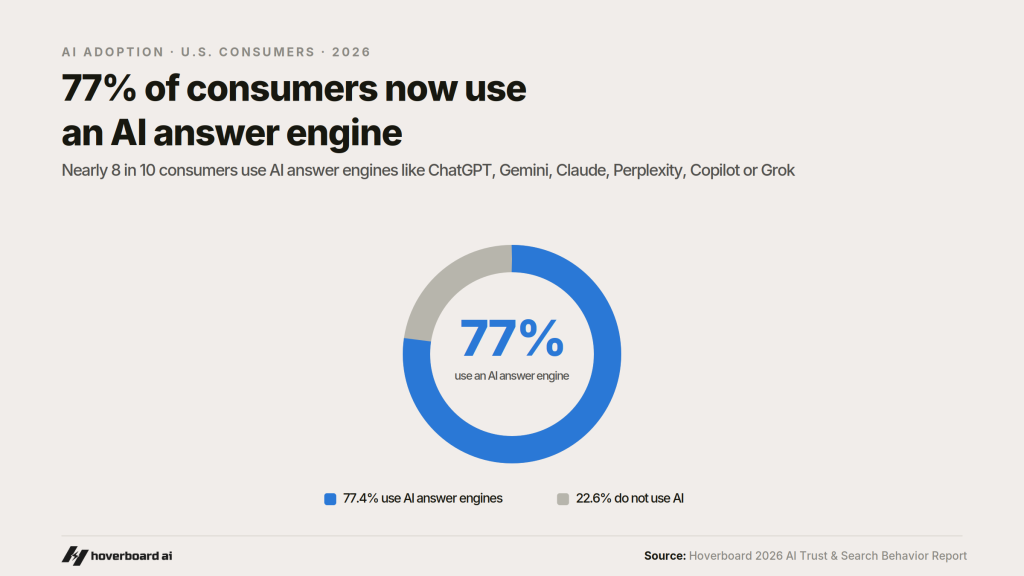
The use of answer engines in the U.S. continues to climb every year since their introduction just a few years ago. Just 23% of respondents report using no AI answer engine at all. Among everyone else, usage is broad and multi-platform: In our study, ChatGPT (not surprisingly) was the dominant player, but Google Gemini numbers are rapidly increasing. More on that below.
Finding 2: ChatGPT is still the leader but Google Gemini is rapidly gaining ground
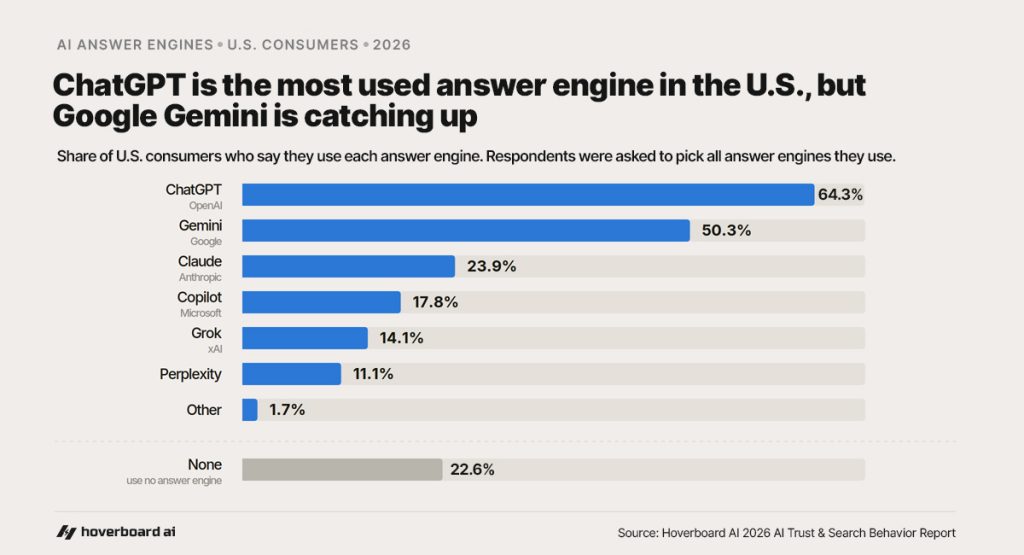
ChatGPT remains the clear leader among AI answer engines in the U.S., used by more than 64% of consumers. But its dominance is no longer uncontested like it was in the last couple years. Google Gemini has climbed to 50%, meaning half of American consumers now use it, and putting it within 14 points of the category leader. That gap matters less than the trajectory: Gemini benefits from distribution advantages no rival can match, woven into Search, Android, Gmail, and Workspace, so its path to parity runs through products consumers already open every day. Behind the top two, a second tier has formed: Claude (23.9%), Copilot (17.8%), Grok (14.1%), and Perplexity (11.1%). Notably, respondents could select every engine they use, and the numbers sum well past 100%, evidence that multi-platform behavior is the norm, and that Gemini’s rise is coming largely alongside ChatGPT rather than at its expense. For marketers, the takeaway is a two-front reality: ChatGPT is still where the most consumers are, but any AI visibility strategy that ignores Gemini is already overlooking half the market, and likely the fastest-growing half.
Finding 3: Trust in AI Answer Engines is Increasing
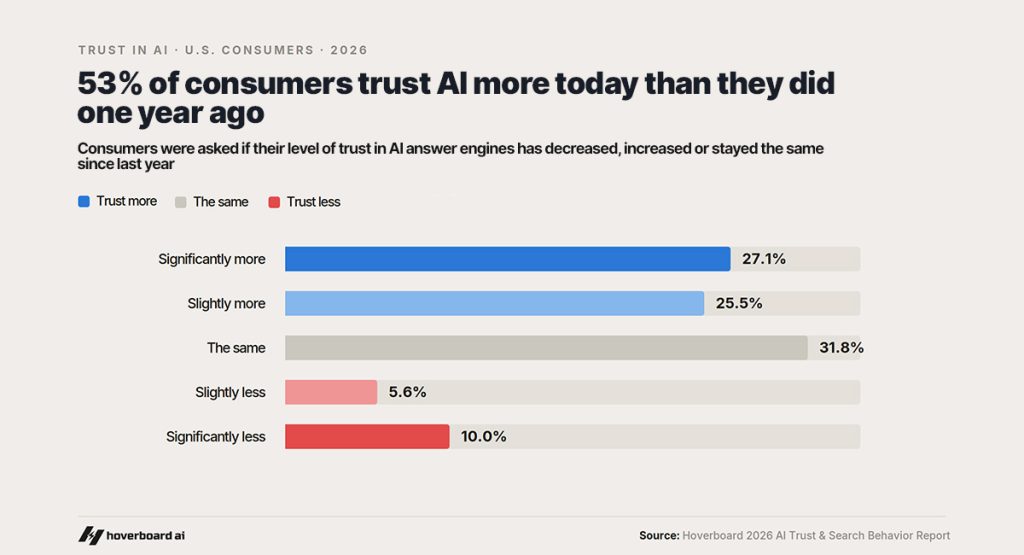
Asked whether they trust AI answer engines more or less than a year ago, respondents who said “more” outnumbered those who said “less” by roughly 3.3 to 1. Less than 16% of participants in our study said they had lower trust in AI compared to 2025, while over 53% said their trust level had increased over that time period. 32% of people said it was the same. Overall consumer trust in AI is continuing to climb each year. People trust the answers that answer engines are giving them, especially when it comes to important purchasing decisions. For most brands, this means the importance of being recommended or mentioned in models like ChatGPT, Gemini, Claude, etc. is higher than ever before. If your company is not paying attention to your visibility on answer engines, you are falling behind your competitors who are.
Finding 4: The average answer engine user has been active on multiple platforms
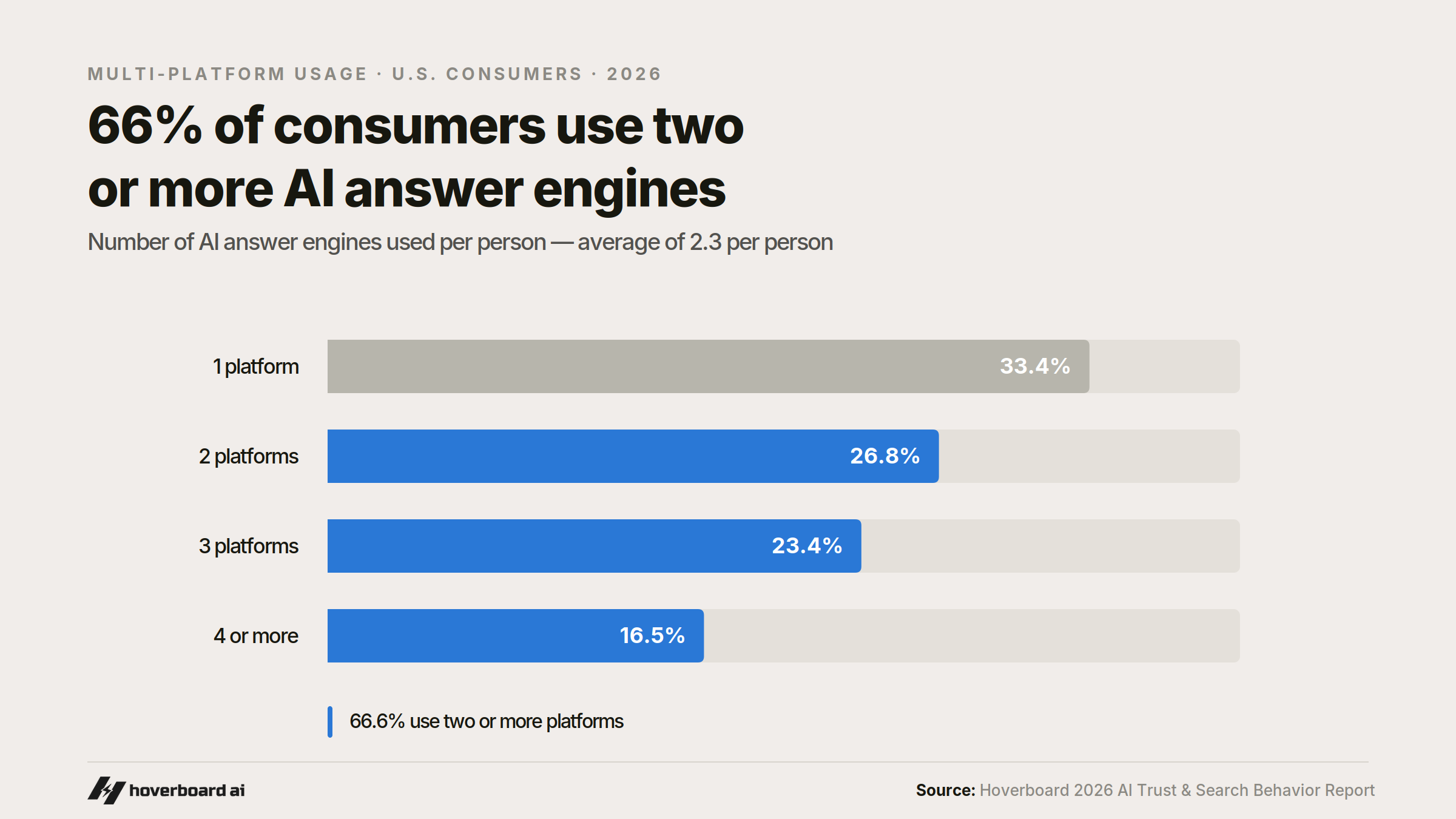
Do most people use multiple answer engines? Yes. In our study, the average was 2.3 answer engines per person. For now, most consumers aren’t loyal to a single AI. Most use (or at least have tried) 2 or more different ones. For brands, that means visibility can’t be optimized for one single model; a brand that’s well-cited in ChatGPT but absent from Gemini may be completely missed by half the people who use answer engines. A brand that has good visibility on Claude, Perplexity, and Grok but never gets mentioned by ChatGPT or Gemini is going to be unknown to the heavy majority of answer engine users.
Finding 5: As income increases, usage of answer engines also increases
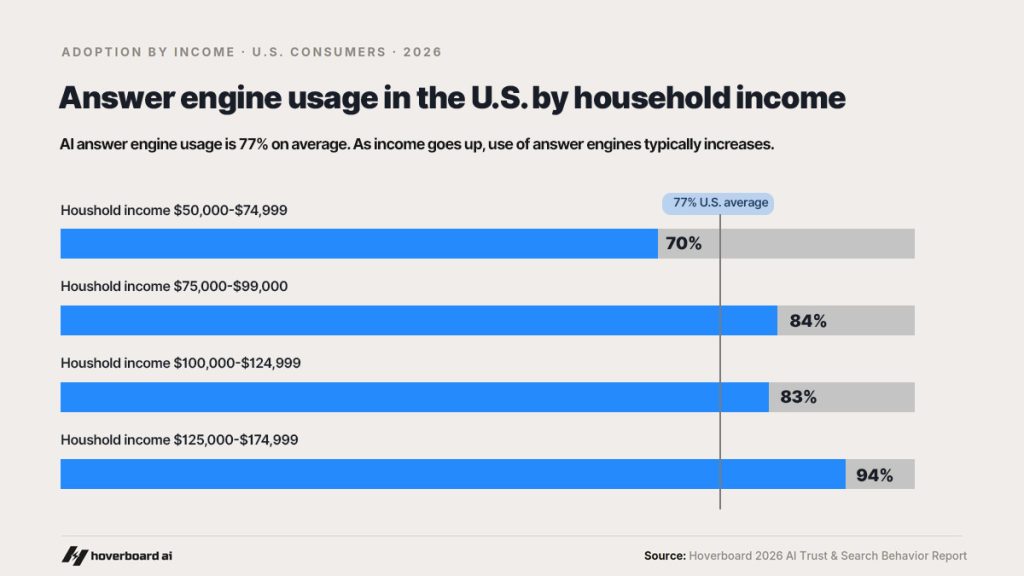
AI answer engine adoption in the U.S. now averages 77%, but usage is more interesting when we dig into the numbers by income levels. Among households earning $50,000–$74,999, adoption sits at 70%, already a strong majority but the lowest of the brackets measured, and below total average. It jumps to 84% for households in the $75,000–$99,000 range, holds roughly steady at 83% for those earning $100,000–$124,999, and climbs to 92% in the top bracket, meaning that among the highest earners, AI answer engines are approaching universal adoption, with fewer than one in ten going without. For marketers and brands, the pattern matters as much as the average: the consumers most likely to be asking ChatGPT, Gemini, or Claude for recommendations are disproportionately the ones with the most disposable income and spending power.
Finding 6: For researching important decisions, Google Search still leads, but answer engines are gaining ground quickly
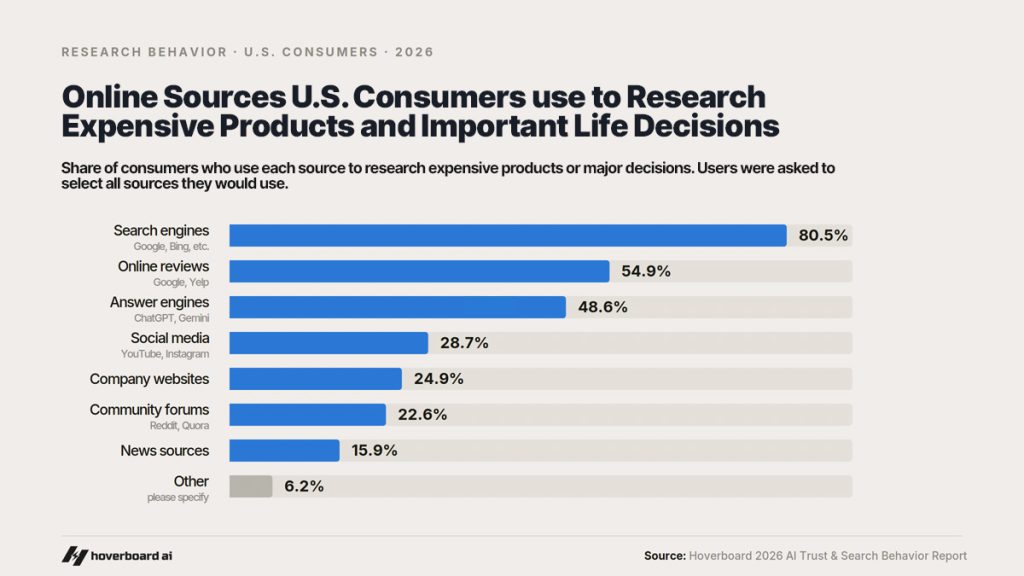
When it comes to researching expensive products or major life decisions, traditional search still leads the way among consumers, but the gap is closing fast. Just over 80% of consumers turn to search engines (primarily Google), keeping search firmly in the top spot. Online reviews follow at 54.9%, a reminder that peer feedback remains one of the most trusted signals in high-stakes decision-making. But answer engines have been gaining ground. Nearly half of consumers (49%) now use AI answer engines like ChatGPT and Gemini as part of their research process. iLawyer Marketing’s 2026 study found 42% of consumers would use an answer engine to help them research which lawyer to hire – up from 9% in 2023, 21% in 2024 and 28% in 2025. For businesses, the implication is clear: being visible in traditional search results is no longer enough. How your brand appears in AI-generated answers is quickly becoming part of the consideration journey.
Finding 7: Among AI users, ChatGPT is the most trusted platform for important decisions
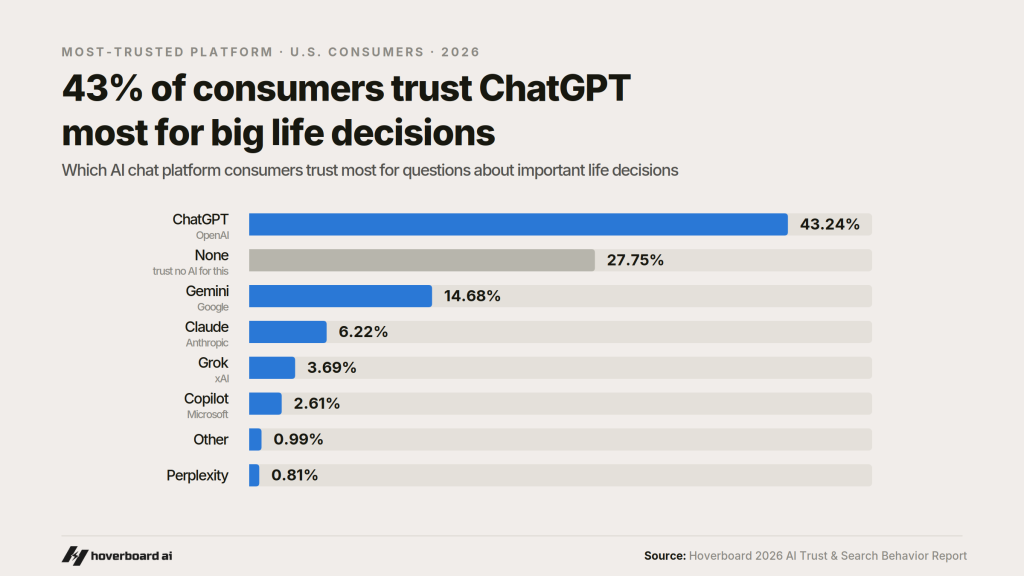
Comparing which platforms consumers use against which one they trust most for important life decisions reveals the most strategically important pattern in this study. ChatGPT converts usage into trust at a rate no competitor approaches: 64% of consumers use it and 43% name it their most trusted, meaning two-thirds of its users are believers. Gemini is used by half of consumers but trusted most by only 15%. Perplexity shows the starkest gap of all: 11% of consumers use it, yet fewer than 1% trust it most, despite its positioning as a research-first answer engine.
The picture sharpens when we filter out the 28% of respondents who don’t trust any AI platform. Among consumers who trust at least one:
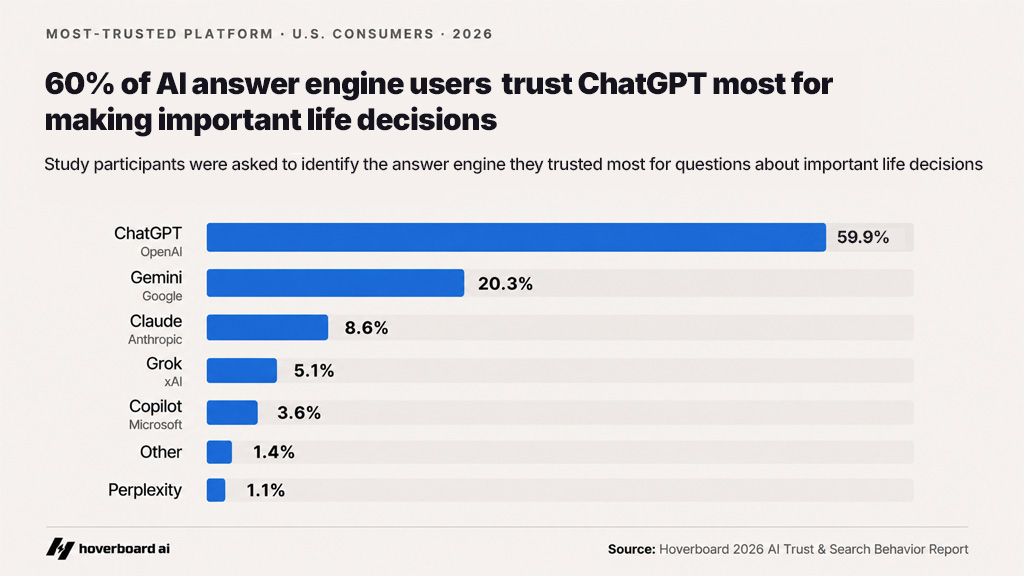
Within this group, ChatGPT is the clear leader. Nearly 60% (59.85%) name it the platform they trust most for important life decisions, roughly triple second-place Gemini (20.32%). Claude follows at 8.61%, with Grok (5.11%), Copilot (3.61%), and Perplexity (1.12%) far behind. In other words, when trust in AI exists at all, it overwhelmingly concentrates in one platform.
For marketers, this reframes the channel question. Gemini’s large reach makes it impossible to ignore, but ChatGPT is where trusted recommendations happen. It is, functionally, where the decision gets made. A brand’s citation footprint in ChatGPT carries disproportionate weight per impression.
Finding 8: The higher the average household income, the greater the trust in AI
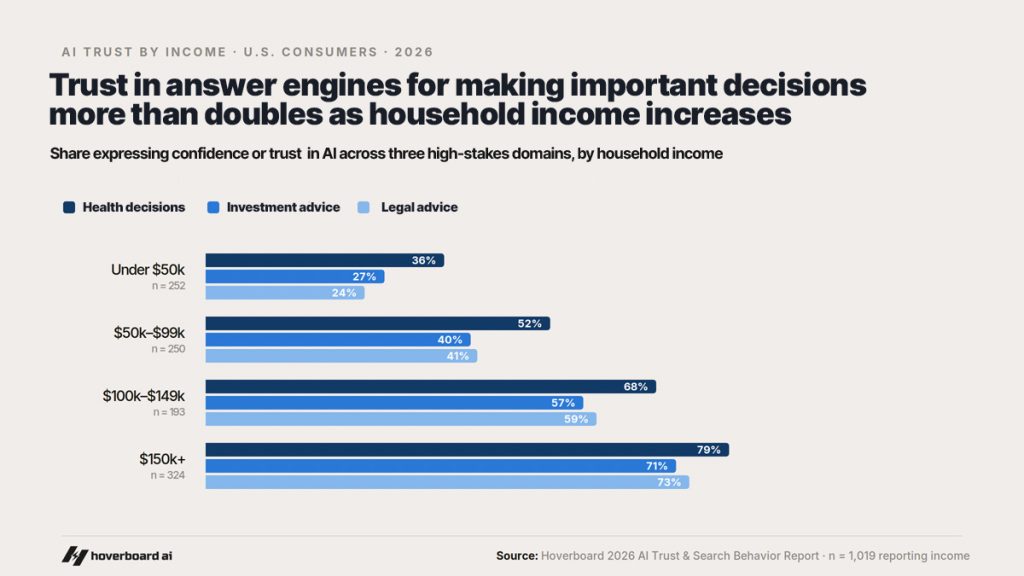
One of the more interesting findings in the study is how sharply trust in AI climbs with household income. Across all three high-stakes domains we measured – health, financial, and legal – trust roughly triples from the lowest income band to the highest. Among households earning under $50k, just 36% are confident in AI’s accuracy for health decisions, 27% would rely on it for investment advice, and 24% would trust it for legal guidance. Among households earning $150k or more, those figures jump to 79%, 71%, and 73%. And it isn’t a two-tier split between “high” and “low” earners. Trust rises step by step through every income bracket, and the pattern holds consistently across all three domains. Whatever the driver… greater exposure to AI tools at work, more discretionary income to experiment with paid tiers, or simply more familiarity breeding more comfort…the takeaway is hard to miss: affluent households aren’t just adopting AI faster, they’re extending it far deeper into consequential decisions about their health, money, and legal affairs.
Finding 9: #1 use case for answer engines is learning/research – #2 is shopping/purchase decisions
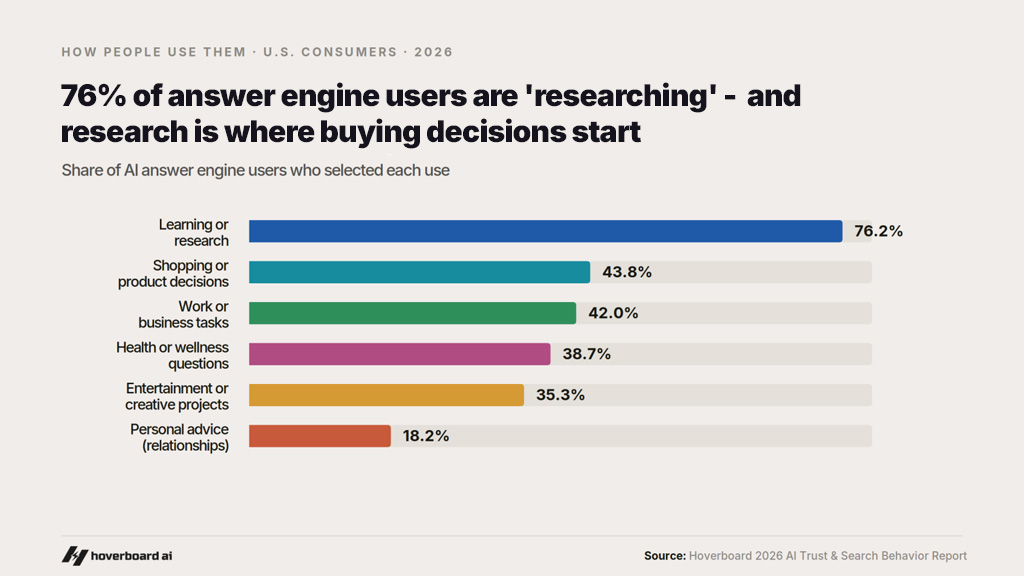
While 43.8% of AI answer engine users explicitly turn to these platforms for shopping and product decisions, that figure dramatically understates their commercial influence. The most common use case, learning or research (at 76.2%), is often shopping in disguise: a consumer “researching” how to lower their cholesterol, insulate a garage, or start running is frequently weeks or days away from buying supplements, materials, or shoes, and the brands an AI names during that research phase enter the consideration set before any shopping intent is declared. The same logic extends down the list. Health and wellness questions (38.7%) shape purchases of everything from fitness equipment to insurance to over-the-counter products; entertainment and creative uses (35.3%) drive decisions about software, subscriptions, and gear; and even personal advice (18.2%), where consumers ask AI how to navigate relationships, career moves, or major life changes, surfaces recommendations for therapists, courses, books, and services at moments of high emotional receptivity. For marketers, the implication is that AI visibility can’t be scoped to explicitly commercial queries. If a business is only being mentioned when users ask “what should I buy,” it’s absent from the much larger volume of upstream conversations where preferences actually form, which means the addressable opportunity isn’t the 43.8% who shop with AI, but something closer to the full 77% of consumers who use these platforms at all.
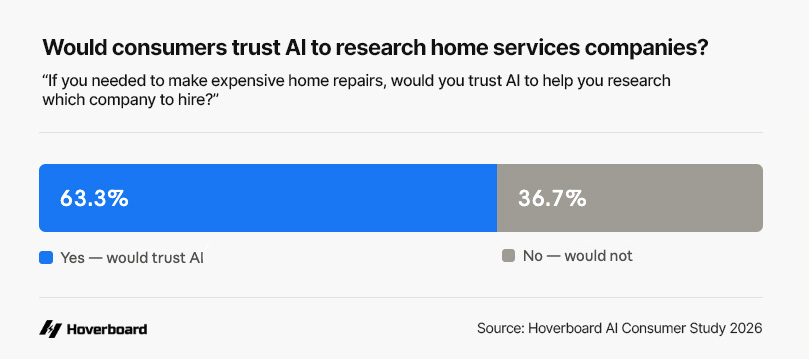
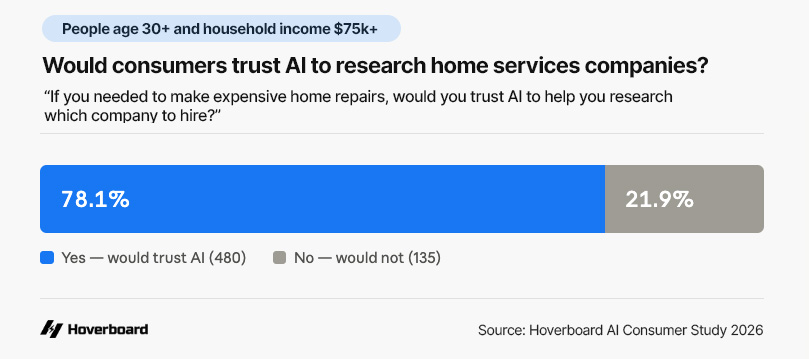
Narrowing this down to people who are more likely to be homeowners (those age 30+ and household income $75,000 or higher), that figure jumps up to nearly 8 out of 10 people who said they would trust AI to help with figuring out which company to hire.
Consumers aren’t just using AI to draft emails and summarize documents: they’re actively bringing them into purchase decisions. Health and wellness questions (39%) and entertainment or creative projects (35%) round out the top five, while personal advice on relationships and life decisions sits well behind (18%). The picture that emerges is of answer engines as an everyday utility: a research assistant first, a shopping companion second, and a work tool close behind.
Finding 10: Trust in AI answers is high for legal, financial and health
Consumers are extending real trust to AI in domains that were, until recently, the exclusive territory of licensed professionals. The pattern across health, finance, and law is strikingly consistent.
Health
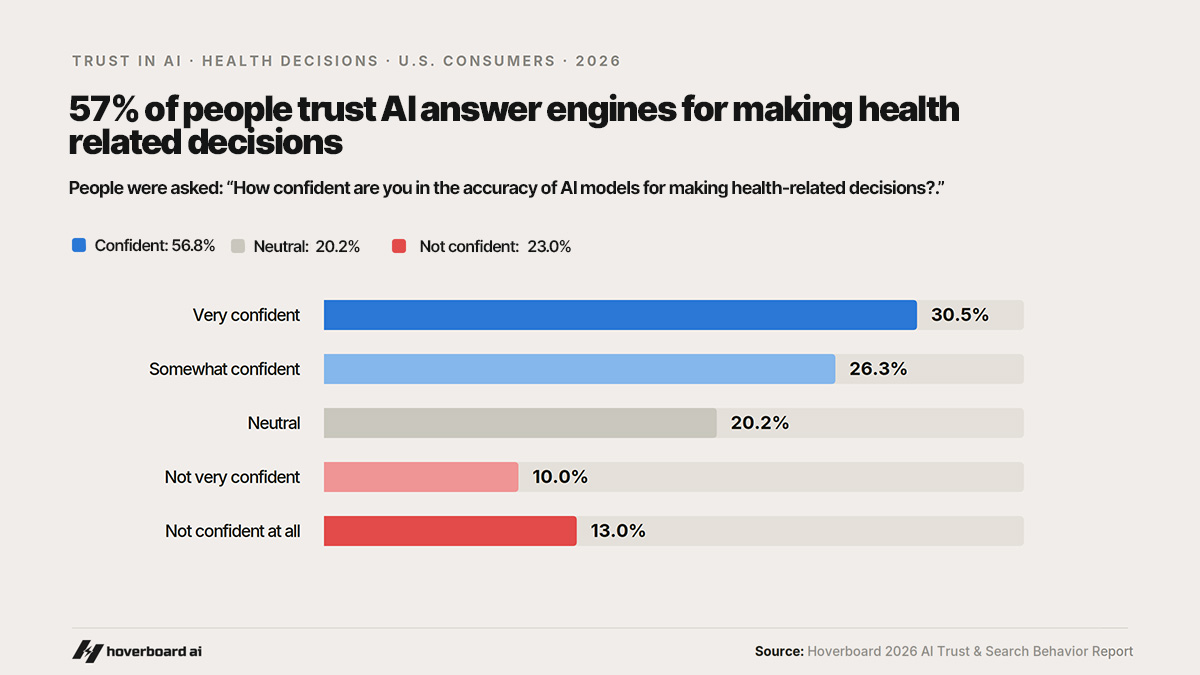
Health leads the way: 56.8% of consumers express confidence in AI’s accuracy for health-related decisions, with nearly a third (30.5%) saying they’re very confident, against just 23% who lack confidence.
Financial
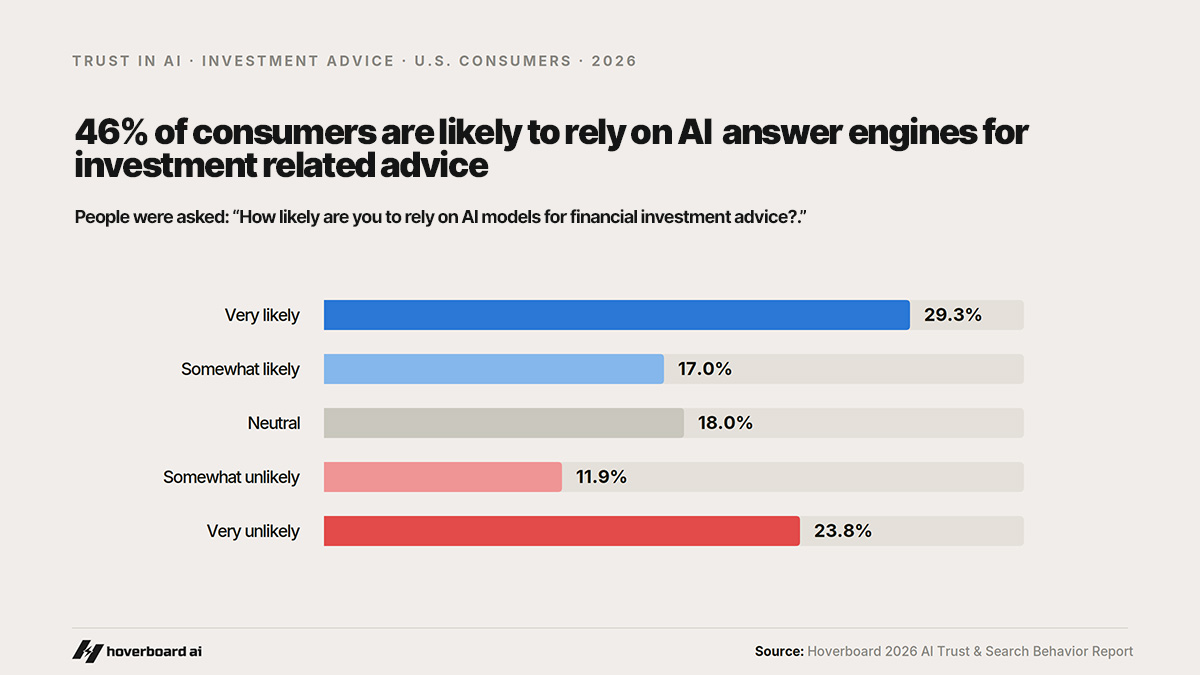
Investment advice follows, with 46.3% likely to rely on AI for financial research and advice versus 35.7% unlikely, notable polarization, as “very unlikely” (23.8%) is the second-largest single response, suggesting money divides consumers more sharply than health.
Legal
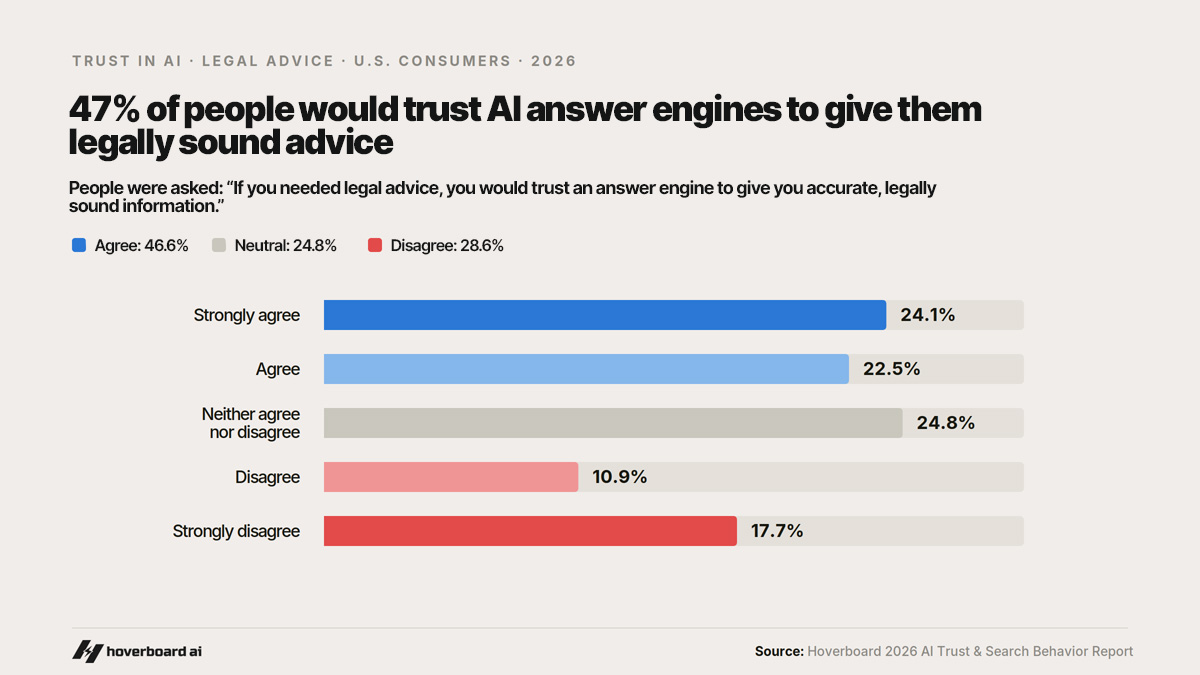
Legal advice rounds out the trio: 46.6% agree they’d trust an AI for accurate, legally sound information, outnumbering the 28.6% who wouldn’t by more than 3 to 2. In every domain, doubters are a clear minority, and the persistent 18–25% neutral block represents consumers whose trust is still up for grabs. The implication for professional-services brands (providers, advisors, firms) is uncomfortable but actionable: roughly half of consumers are already willing to take high-stakes guidance from AI, which means the question is no longer whether clients will consult an AI before consulting you, but what that AI will say when they do.
What this means for marketers and business owners
Search behavior has fragmented, and the fastest-growing piece is one most brands can’t yet see into. Nearly 8 in 10 people in the U.S. use answer engines. Half of consumers run important life or purchase decisions through AI answer engines. The majority of consumers now have conversations with AI to help them figure out what companies they hire, what products they buy and what health and medical decisions they make.
That makes AI visibility extremely important for brands looking to grow revenue through online marketing. Answer engines are a channel that brings great growth opportunities to companies, the way organic search first did two decades ago. GEO (Generative Engine Optimization), AEO (Answer Engine Optimization), AI Optimization (or whatever you prefer to call it) is growing in importance and will continue to do so. The work starts with measurement: knowing whether models mention your brand, how they frame it, which sources they cite for it, and how that compares to competitors. Brands establishing that citation footprint now are building consideration-set position in a channel whose influence (per every trendline in this report) is still compounding.
Aside from the obvious here that it’s important for brands to try and earn high visibility on answer engines “organically”, running paid ads on ChatGPT should be something that brands should consider. ChatGPT now has over 1 billion active users, so the eyes are there. Ads are increasingly now appearing in ChatGPT responses. At Hoverboard AI, we’ve observed ads showing up in nearly 60% of all the prompts we’ve tracked in July, jumping up from less than 3% in early June. Hoverboard AI recently added the ability for users to see what ads are running for the prompts being tracked on your campaign, inside our app. This can give you ad inspiration, as well as to allow you to see what competitors and companies are running ads for the prompts you want visibility for.
Last, it’s clear that certain answer engines are much more important to have visibility in: ChatGPT and Google Gemini. ChatGPT is clearly the dominant player right now. It dominates market share and trust levels among users of AI. But, Gemini has been growing and will continue to do so. Gemini has over 900+ million users as of May 2026. Google has said they get over 5 trillion searches annually, which means they get over 13 billion searches made every single day on Google search. With AI Overviews appearing on nearly every query based search (as well as many non-query based ones) plus with Google AI Mode, Gemini user numbers will absolutely continue to climb.
While you shouldn’t simply ignore the other answer engines, if you are wanting to improve your visibility on answer engines and increase brand awareness, your focus should be on these two giants.
Methodology
Hoverboard AI surveyed 1,097 U.S. adults between April-June 2026 about their use of and trust in AI models and all the major answer engines (ChatGPT, Gemini, Grok, Claude, Perplexity, and Copilot). Age range was 18-65. At a 95% confidence level, the approximate margin of error for full-sample figures is ±3 percentage points. All figures are self-reported and rounded to the nearest whole percentage point; multi-select questions can sum to more than 100%. On the year-over-year trust question, results are reported as a ratio of respondents reporting increased versus decreased trust. Percentages describe survey respondents. Results are intended to describe directional consumer behavior among surveyed U.S. adults, not audited platform usage.
Hoverboard AI is an AI search analytics and Generative Engine Optimization (GEO) platform that tracks how brands are mentioned, cited, and framed across ChatGPT, Gemini, Google AI Mode, Google AI Overviews, Perplexity, and other AI models.
Republishing: charts and statistics from this report may be reproduced, we just ask for attribution to “Hoverboard AI” via a mention or a link to this study.